Strapi and AI: How Modern Content Teams Are Automating Content Operations
Content operations at scale have been inherently slow. The editors beg for approval, developers create integrations manually, and marketing professionals spend too much time moving their content from one platform to another instead of creating it. And this is where automation based on AI comes in, and Strapi, being a versatile headless CMS, becomes a perfect part of the game.
And while developing content management systems that use Strapi, the challenge is not whether you will integrate AI but how fast you will do it without becoming a burden for the maintenance team.
Strapi + AI: The Perfect Pair
Strapi has an API-first approach. All the features of the CMS - content types, entries, media, and permissions - are available through the REST API or GraphQL. This feature makes it very easy to integrate AI services with your CMS without touching its core functionality.
Unlike other classic CMSs, where you have to tweak a monolith CMS for integrating an AI service, Strapi provides you with a good opportunity to extend its functionality using lifecycle hooks, custom routes, middleware, and plugins.
1. Automated Content Enrichment on Entry Creation
The first and the most obvious advantage is implementing AI enrichment by making use of Strapi's lifecycle hooks immediately after content saving.
Example: A blogger creates a draft version of his blog post and, before it gets saved to the database, a beforeCreate or afterCreate hook makes an API call to some AI service, like OpenAI, Anthropic, or custom LLM to get a meta description or optimized title.
// In /src/api/article/content-types/article/lifecycles.js
module.exports = {
async afterCreate(event) {
const { result } = event;
const aiSummary = await generateSummary(result.body);
await strapi.entityService.update('api::article.article', result.id, {
data: { seo_description: aiSummary },
});
},
};
Benefits:
- Eliminates manual SEO tagging every entry ships with metadata
- Reduces dependency on editors for repetitive enrichment tasks
- Consistent output format across all content entries
- Hooks into existing publish workflows with zero editor friction
2. AI-Powered Content Moderation and Classification
Manual moderation is not feasible for platforms with user-generated content or high editorial traffic. Strapi's middleware allows you to intercept the inbound content and classify it using your own models before it gets saved anywhere.
Example: A marketplace platform manages the product descriptions submitted by their vendors using Strapi. They use middleware that verifies whether the inbound content passes a content safety API check.
// Custom middleware in /src/middlewares/ai-moderation.js
module.exports = (config, { strapi }) => {
return async (ctx, next) => {
if (ctx.request.method === 'POST' && ctx.request.url.includes('/listings')) {
const { description } = ctx.request.body.data;
const classification = await moderateContent(description);
ctx.request.body.data.status = classification.safe ? 'approved' : 'flagged';
}
await next();
};
};
Benefits:
- Scales moderation without scaling headcount
- Catches issues before content reaches the database
- Audit-ready classification results are stored alongside the content entry
- Pluggable: swap AI provider without changing business logic
3. Intelligent Search and Content Discovery
The default filtering in Strapi is field based. Vector embeddings can be added to the content for semantic search where content can be found based on meaning and not just keywords.
Example usage: The internal knowledge base powered by Strapi should return relevant articles when a support specialist makes a natural language request. When the content is saved, the body is passed through an embedding model (like OpenAI text-embedding-ada-002) and vector is stored in Postgres pgvector or a separate vector store (Pinecone).
Benefits:
- Search returns relevant results even when keywords don't match
- Enables recommendation engines ("similar articles") without custom logic
- Reduces content duplication teams can find existing content before creating new entries
- Works alongside Strapi's existing GraphQL/REST queries
4. Automated Localization Pipelines
Localization and translation are among the most frequent processes in any content management system. The i18n plugin for Strapi offers the multi-language configuration, while AI takes care of the translation itself.
Scenario: A software-as-a-service firm runs its product content on Strapi in 12 locales. An entry in English language is published, a webhook triggers a serverless function, which requests translation via DeepL or GPT-4 for every locale, and creates localized entries using the Strapi Content API.
Benefits:
- First-draft translations ready the moment English content publishes
- Reduces time-to-market for international releases from days to minutes
- Human translators focus on review, not initial drafts
- Locale coverage scales without scaling translation budgets
5. Using AI for Content Creation Through Custom Plugins
In cases where there is a need to bring AI functionality right into the Strapi admin dashboard, you would need to create your own custom plugin that would allow for such actions.
Use case: The editorial team will get a sidebar in the article editor, where alternative titles will be suggested, bullet points turned into sentences, or where the text will be rewritten for a different level of readership.
Benefits:
- Keeps editors in one tool instead of context-switching to external AI tools
- AI output stays within your content governance model
- Usage is trackable and controllable at the platform level
- Extensible add new AI actions as plugin features without rebuilding the CMS
Best Practices for AI-Strapi Integrations
- Integrate rate limiting in AI calls, as lifecycle hooks may trigger on scale; manage your API quota with throttling or queuing.
- Keep AI outputs as separate fields to make sure that AI content is isolated from human-created content.
- Graceful failure wraps your AI calls with try-catch blocks and specify what to do when an API call fails in order to prevent your content save process from failing because of it.
- Prompt versioning considers prompt strings as code. Keep them in configuration files and make sure they are versioned.
- AI output quality monitors the quality of your AI output, as it will help you find problems with prompts or models.
Conclusion
This is not about automating the work of the content team; rather, this is about automation of all the boring tasks. It is easy to see how enrichment, moderation, localization, and even discovery can be automated by the AI first so that people do the rest.
For the development community, Strapi offers a flexible architecture that makes integrating an intelligent solution easy. Life cycle hooks, middleware, custom extensions, and well-designed API allow you to extend rather than fight with your CMS.
There is no need to wait for the day when there will be AI CMS available out-of-the-box. The winning teams are implementing the pipelines today using the tools that they already have.

Related Blogs
Strapi is a effective headless CMS, and Docker makes it incredibly clean to run it…
Read More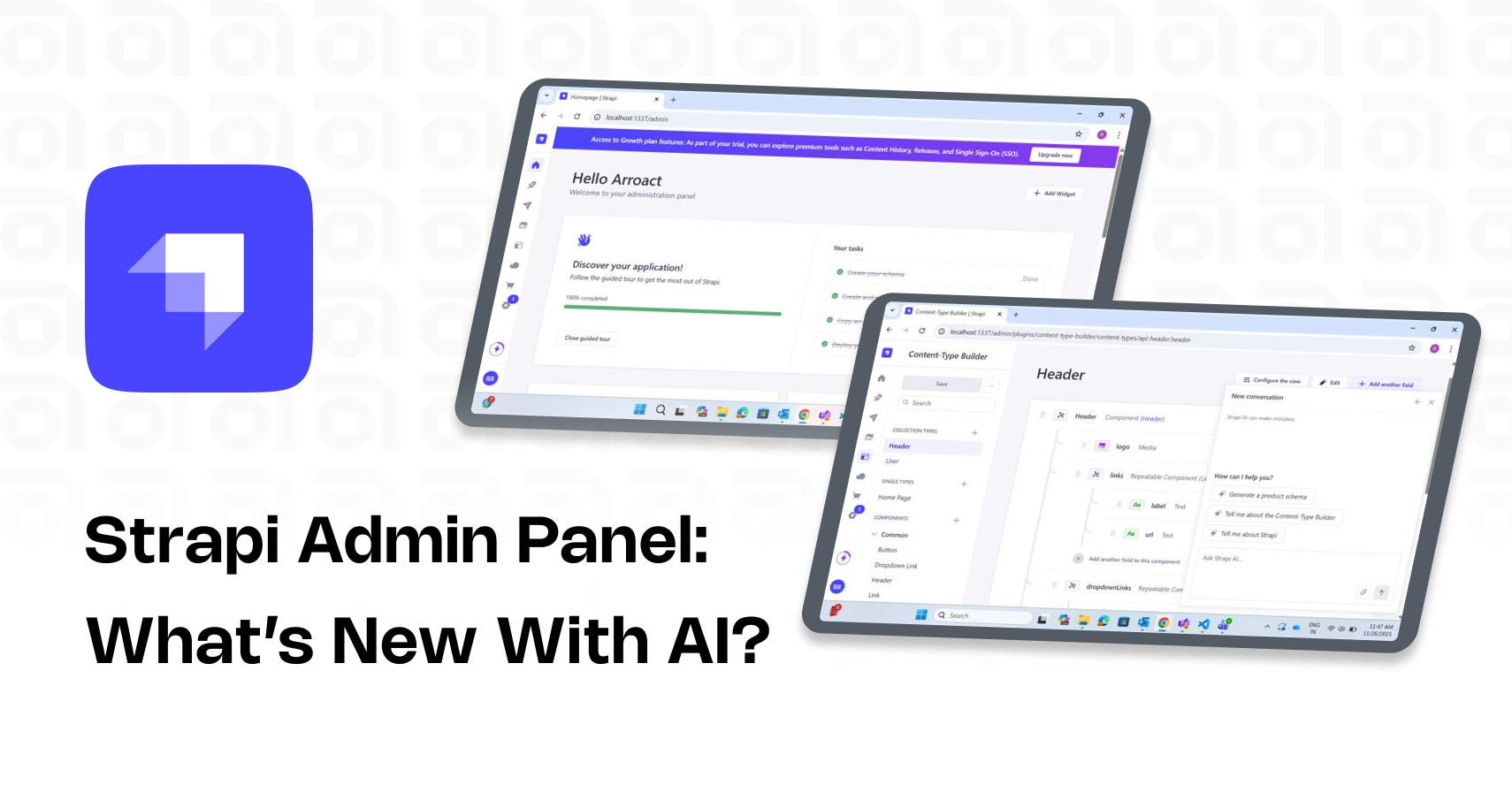
Before we start exploring the Strapi admin panel, we first want to apprehend what Strapi…
Read MoreArroact is ready to help you grow.
Our Office

Westface, 519/520, Bhagwat Bungalows Rd, Thaltej, Ahmedabad, Gujarat 380059


Pay us a visit for a cup of coffee. We’ll be more than happy to welcome you.