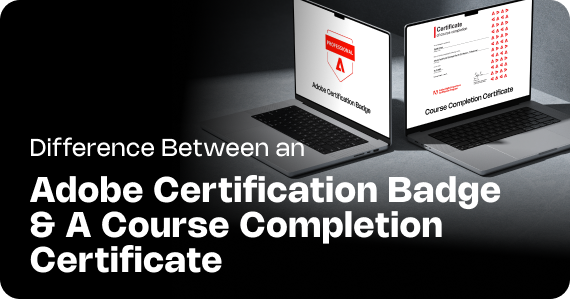
Difference Between an Adobe Certification Badge and a Course Completion Certificate
If you’re learning Adobe Experience Manager (AEM), you’ve probably come across two things that seem similar at first: course completion certificates and certification badges.
At first, they can feel almost identical: both look like achievements, both come from Adobe, and both seem worth sharing. But they represent very different milestones in your journey as a developer.
Understanding the difference is important for developers who want to clearly showcase their learning progress, technical knowledge, and verified expertise within the Adobe ecosystem.
Course Completion Certificate (Learning Achievement)
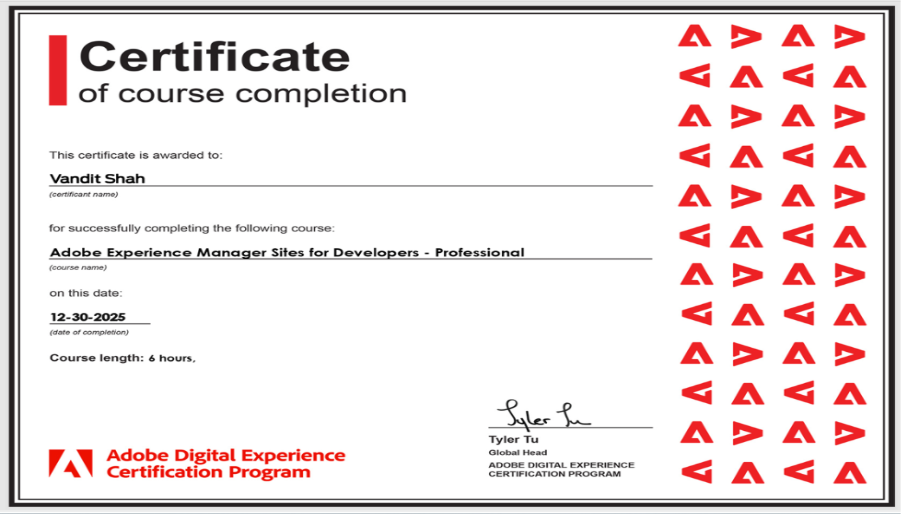
You earn a course completion certificate after completing the official Adobe training course.
For example, developers who complete the Adobe Experience Manager Sites for Developers Course receive a certificate acknowledging that they have completed the learning program.
These courses are meant to help you understand how AEM works without overwhelming you. You’ll go through modules, follow along with tutorials, try out a few things yourself, and answer some quizzes along the way.
Once you’ve completed all the lessons and activities, the certificate acts as a recognition of your effort and learning progress.
What the Course Certificate Represents
A course completion certificate indicates that the learner has:
- Completed the official learning modules
- Understood the core concepts of AEM development
- Participated in an Adobe training program designed to build foundational knowledge
This certificate demonstrates commitment to learning and skill development, which is especially helpful for developers who are beginning their journey with AEM.
Important Point
It is important to understand that a course completion certificate does not require passing a professional certification exam.
It only confirms that the learner has gone through the training materials and completed the course successfully.
While it reflects learning progress, it does not formally validate professional expertise.
Certification Badge (Professional Achievement)
A certification badge is awarded only after you pass an official Adobe certification exam like the AEM Sites Developer Professional Exam (ADO-E128).
Unlike course completion, this exam evaluates a developer’s ability to apply AEM knowledge in real-world development scenarios.
The certification exam typically assesses skills related to:
- AEM architecture and core concepts
- Sling framework usage
- OSGi services and configurations
- AEM component development
- Client libraries and front-end integration
- Development best practices within the AEM platform
Once a candidate passes the exam, Adobe issues a digital certification badge along with a verifiable credential.
What the Certification Badge Represents
A certification badge confirms that the developer has:
- Demonstrated professional-level AEM development skills
- Proven knowledge of important AEM technologies such as Sling, OSGi, and component development
- Met Adobe’s official certification standards
- Achieved recognition as an Adobe Certified Professional
These badges are commonly shared on LinkedIn, developer portfolios, and resumes as proof of verified technical expertise.

Quick Comparison Between Course Completion Certificate and Certification Badge
| Feature | Course Completion Certificate | Certification Badge |
| How it is earned | Completing the official training course | Passing the certification exam |
| Purpose | Learning achievement | Professional validation |
| Difficulty | Basic to intermediate | Professional level |
| Recognition | Shows learning progress | Industry-recognized credential |
| Example | AEM Sites Developer Course Certificate | AEM Sites Developer Professional Badge |
| Value | Educational achievement | Professional certification |
One reflects effort and progress.
The other reflects capability and credibility.
Typical Learning Path for AEM Developers
For many developers, the journey usually follows a structured learning path within the Adobe ecosystem.
A common progression looks like this:
- Start with Adobe learning resources and documentation
- Complete official AEM developer courses and training modules
- Gain hands-on experience by working on AEM components and projects
- Attempt the AEM Sites Developer Professional certification exam
This approach allows developers to first build their conceptual understanding, then validate their skills through industry-recognized certification.
A Real Example
A developer working through the Adobe learning ecosystem might earn both credentials during their journey.
For example:
- Certificate → Earned after completing the AEM Sites Developer course
- Badge → Earned after successfully passing the ADO-E128 certification exam
This means:
- The certificate confirms the completion of training and learning modules
- The badge confirms that the developer passed the official certification exam
Together, these achievements demonstrate both learning effort and validated expertise.
Final Thoughts
In the Adobe learning ecosystem, both course completion certificates and certification badges serve valuable purposes.
A course certificate reflects a developer’s commitment to learning and completing structured training programs. It shows that the individual has taken the time to understand the fundamentals of AEM development.
On the other hand, a certification badge provides stronger professional validation because it confirms that the developer has successfully passed a recognized certification exam and demonstrated practical knowledge of the platform.
For developers working with Adobe Experience Manager, earning both credentials can significantly strengthen their professional profile by showcasing continuous learning, practical knowledge, and verified expertise in the Adobe ecosystem.

Related Blogs


Read More

Read More

Read More